Essay · 18 October 2026
Why your crew won't use another app (and it's not about the app)
Contractors don't reject reporting tools because the reports are bad. They reject them at the install screen.
Every construction software pitch ends the same way: a great demo, a nodding project manager, a pilot on one site. Three months later the foreman has stopped logging, the login is forgotten, and the subscription quietly renews for nobody. It usually gets blamed on training. It is closer to a physics problem: you cannot push behaviour change uphill through a dozen phones and expect it to stay there.
The phone in the foreman's pocket
Picture the actual device. A mid-range Android, two years old, cracked corner, little free storage, most of it taken by family photos and a pile of WhatsApp groups he can't leave because work lives in them. When a software vendor says "just have the crew install our app," here is what they are really asking: clear space, create an account, verify the email, grant a list of permissions, learn a new workflow, and do it all again every time a worker joins or a phone gets replaced.
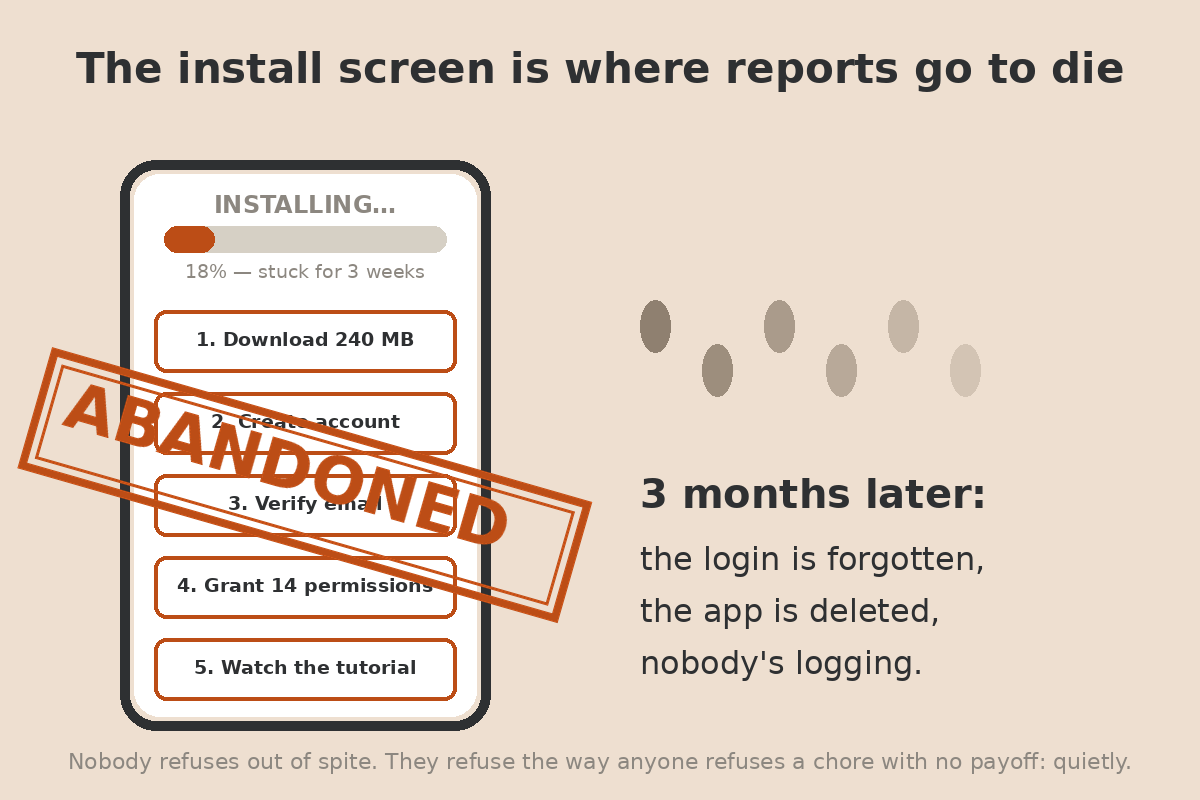
Nobody refuses out of spite. They refuse the way anyone refuses a chore with no visible payoff: quietly, by not doing it. The foreman who was keen in the demo is the same foreman who, at 7pm after ten hours on site, is not creating an account.
The real bill isn't the subscription
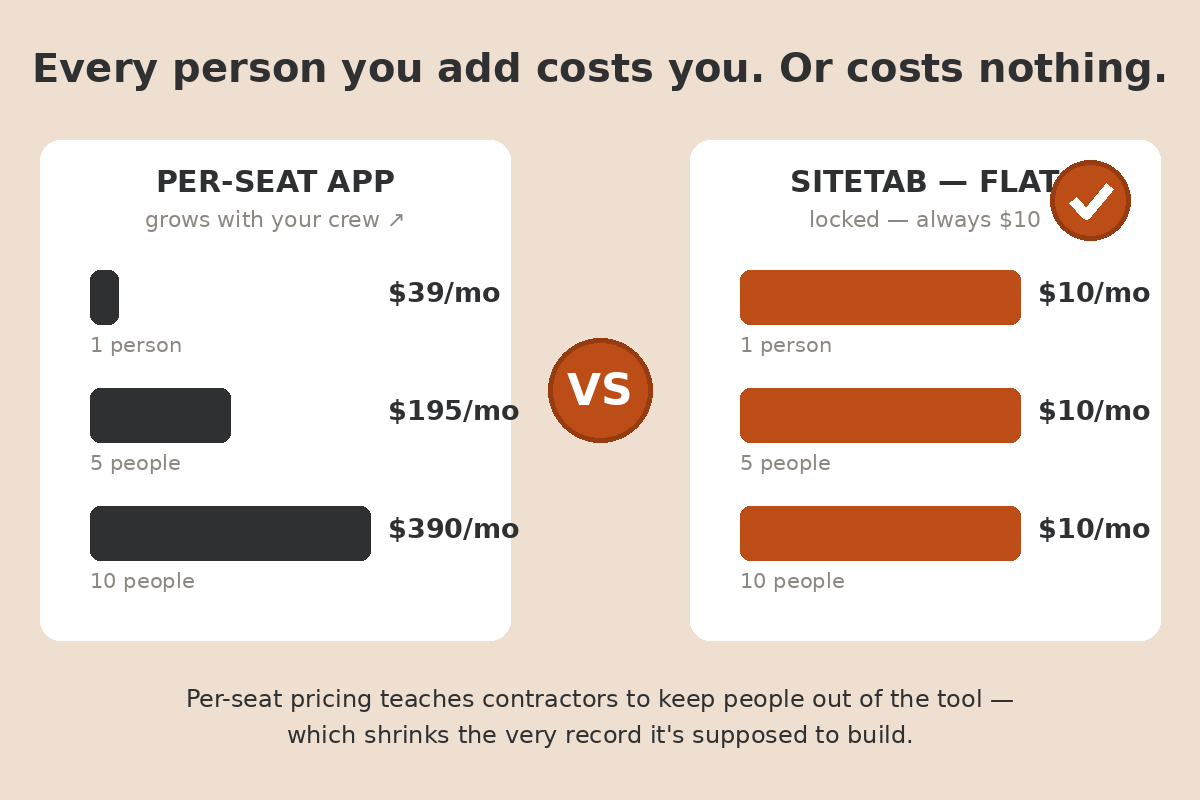
This is the part pricing pages hide. Say a tool costs $39 per user per month (an example price, to show the maths). For a 12-person crew that is not one subscription. It is twelve installs, twelve accounts, twelve people to train, and a permanent part-time job chasing the ones who stop logging. Then a worker leaves, a new one arrives, and the setup starts over. Crews change from job to job, and every departure deletes the training you paid for.
Vendors price per seat because it scales their revenue with your crew. It also scales your setup burden with your crew, which is the opposite of what a small contractor needs.
Per-seat pricing teaches you to keep people out
Here is the perverse incentive nobody talks about. When every person on the tool costs money, the rational move is to limit who gets in: just the foreman, maybe the PM. The helpers, the subcontractors, the client watching from abroad stay out.
But a site record is only as good as its coverage. Fewer people contributing means thinner reports, more gaps, less trust in the data. That makes the tool less useful and renewal harder to justify. Per-seat pricing doesn't just cost more as you grow. It shrinks the record it is supposed to build.
The crew is already somewhere
Now look at what is already on that phone. WhatsApp: installed, logged in, checked forty times a day. The crew sends site photos there without being asked. They send voice notes when typing is too slow. They argue about deliveries there. The behaviour you need, documenting the site as it happens, already exists. It is just scattered across chat threads instead of sorted into a record.
That is the whole argument: don't move the crew. Meet them where they are. Any tool that starts with "first, change how your people behave" has already lost to the tool that starts with "keep doing what you're doing."
Judge tools by the first ten minutes
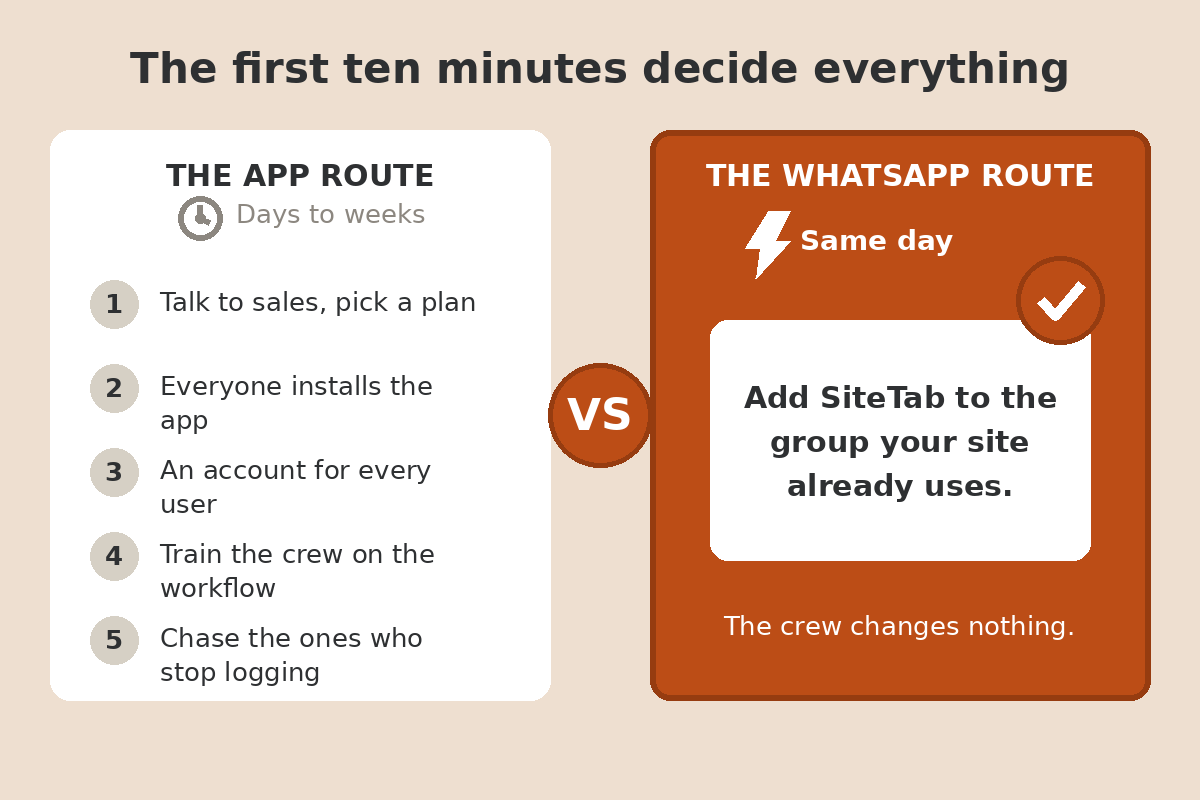
So when you are evaluating reporting tools, skip the feature matrix. Ask one question instead: what stands between deciding to try this and the first report existing?
If the answer involves installs, accounts, configuration and training, multiplied by every person on site, you are not buying software. You are buying a change-management project with a monthly fee. On a small site, nobody has time for that.
The best reporting tool for a small crew is not the one with the most features. It is the one the crew can't avoid using, because using it means doing nothing differently at all.
Your crew already does the work. The report should write itself.
SiteTab is a WhatsApp contact you add to the site group you already have. It files what the crew posts as issues, progress, materials, approvals and documents, and drafts the daily report for you to review before you share it. One group, $10 a month, 7-day free trial. Nothing for your crew to install.
Start your 7-day free trial No card needed.